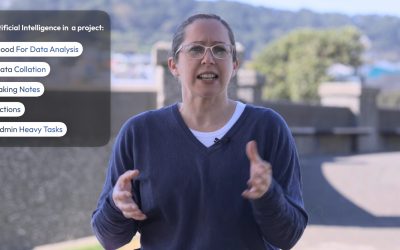
TLDR: AI tools are arriving in New Zealand’s project management landscape faster than most organisations know what to do with them. They offer real productivity benefits, particularly in document drafting and data aggregation, and the time savings on routine work are genuine. But at IQANZ, our view is clear: AI output needs an experienced human lens applied to it, and the risk of AI being used to compensate for a lack of experience rather than to amplify genuine capability is already visible in practice. There is also a structural problem on the horizon that the profession has not yet grappled with seriously: if AI eliminates the junior roles through which project management expertise is built, the experience pipeline dries up, and the system eventually collapses when the last generation of truly experienced practitioners retires.
There is a version of the AI in project management conversation that is entirely about productivity gains. Documents drafted faster. Reports compiled in minutes. Meeting minutes generated automatically. Status updates pulled together from multiple data sources without anyone spending half a Friday afternoon doing it. That version is real. AI tools are already supporting project teams in meaningful ways, and anyone who dismisses them may already be on the back foot.
But there’s another version of this conversation, and that’s the one we’re more interested in. It’s about what AI can’t do, and what happens when organisations assume it can. It’s about the difference between output that looks right and output that is right, and about the experienced professional judgment that’s the only thing which can tell those two things apart. And it’s about the long-term structural question of what happens to the project management profession, and to the quality of project delivery in New Zealand, if AI is used to replace the people who are still building that judgment.
When AI Can Be Good in Project Delivery
AI massively supports the drafting of project artefacts and control documentation. Status reports, meeting summaries, risk log entries, change request templates, communication plans: these are routine, time-consuming, and often formulaic. AI can produce a credible first draft of any of them faster than a human can, and the time that frees up is time that can go toward the work that actually requires human judgment.
Data aggregation is another legitimate use case. Project teams routinely need to pull information from multiple sources, synthesise it into a coherent update for governance, and present it in a form that allows decision-makers to act on it. Pulling a bunch of information into a status report, for instance, AI can break the back of a lot of time-consuming grunt work. The AI-generated synthesis needs human review, but it gives the reviewer something to work with rather than a blank page, and it can surface connections across data sources that a human working under time pressure might miss.
Digital.govt.nz has published guidance on the responsible use of AI in the New Zealand public sector, and the principles it sets out are consistent with our position: AI as a tool in support of human decision-making, not as a substitute for it. The guidance is worth reading, and its emphasis on maintaining accountability with the person using the tool, rather than delegating it to the tool itself, is important.
But Human Intelligence Is Vital
Here’s where the conversation gets more important. The value of any AI output in a project context depends entirely on the quality of the human review applied to it. And the quality of that review depends on the experience of the person doing it.
An experienced project manager reviewing an AI-generated risk log will know with little effort what’s missing, what’s understated, what the AI hasn’t understood about this specific project’s context, and what years of working on similar projects would say about the risks it hasn’t identified. A less experienced person reviewing the same document may not see any of those gaps. They may see a well-formatted, professionally worded risk log that covers the obvious bases, and conclude that it’s fine. But it’s not fine; it’s incomplete. However you need the experience to know that.
AI can pull from various information sources and aggregate them quickly, but it needs someone to sit alongside the output and ask: is this accurate? Has it been pulled together in the right way? Is this actually going to support governance to make a good decision? Without that lens, AI output is not a starting point. It’s a risk.
The emotional intelligence and nous that humans bring to professional work is difficult to replicate. An experienced project manager can look at a schedule and know instinctively where the risk lies, with all of that pattern recognition built in over years of doing it. To get AI to replicate that, you have to type out all of the context it would need to make a meaningful assessment, at which point the human already knows the answer. That instinctive judgment is not available by prompt.
Artificial Intel, Human Reality Check
Our concern about how AI is being used in project delivery right now is specific and grounded in what we are actually observing in practice. There’s a growing risk of people overestimating their capability because they have an AI tool working alongside them. The human lens is not being exercised, and the AI output is being taken as gospel by people without the experience required to critically assess it.
This isn’t a theoretical risk. Project teams are already using AI tools to generate risk assessments, project plans, and status updates that are being reviewed less carefully than they should be. The output looks polished. It uses the right vocabulary. It has the right structure. In many cases, it is right-ish, but it misses the context, the nuance, and the specific organisational dynamics that an experienced professional would bring. The person reviewing it only knows what’s missing if they know the subject well enough to notice.
There’s a phrase that captures this precisely: unvetted by experience. AI output, however confidently presented, carries no track record, no lessons from past failures, and no understanding of the specific people, politics, and dynamics of the organisation it’s describing. Experience is what allows a professional to evaluate it properly. Without that, the output is unvetted. And unvetted is dangerous on a complex, high-stakes programme.
AI is a Robot, it Lacks Nuance
There’s a dimension of project management that AI is nowhere near replicating. Project management is full of grey. There are lots of different ways to do things. There is enormous nuance. The work of understanding that nuance and making the right trade-off decisions in context isn’t something AI can do yet. We certainly haven’t seen it.
The grey in project management is a judgment problem. Which risk is worth escalating and which is better managed at team level? When does a scope request represent genuine value and when is it creep that needs to be resisted? Is this milestone slippage an early warning of a deeper problem or a normal fluctuation? These questions don’t have textbook answers that can be looked up or algorithmically derived. They have contextually appropriate answers that depend on the specific project, the specific organisation, the specific relationships, and the accumulated experience of the person making the call.
Consider a governance board meeting being transcribed by an AI tool. The words are captured accurately. But “I guess we could do it by that date” reads identically in a transcript whether it was said by someone who was quietly confident or someone who was deeply anxious and felt unable to say no. Only a human in the room can make that distinction.
The Experience Pipeline Problem
The most significant long-term concern we have about AI in project delivery is not about the quality of individual outputs or the risk of over-reliance, important as both of those are. We’re more concerned about the experience pipeline that sustains our profession.
Here’s our argument. If teams shrink because AI handles enough of the work, you still need really experienced people to lead the teams. But how do you get that experience? If AI does all the junior-level work, there are no humans doing the junior-level work. The pipeline disappears. And, at some point, the system dies: when all of those really experienced project managers retire, and there is nobody coming up behind them who has built judgment through years of doing the hard stuff themselves.
Project management expertise is not acquired by reading about it or by reviewing AI-generated documents against a checklist. It’s built through years of making decisions under pressure, making mistakes and recovering from them, working alongside people who have been doing it longer, and slowly developing the spidey-sense that allows an experienced professional to walk into a programme and know within an hour where the real risks are. Remove the entry point to that journey, and within a generation, the pipeline is gone.
What this means for New Zealand specifically
New Zealand is a small professional market. The pool of truly experienced programme and project professionals is limited, and the demand for them from both the public and private sectors is consistent and often intense. The Infrastructure Commission has noted the importance of capability development in the delivery of New Zealand’s infrastructure pipeline, recognising that technical investment without the human capability to deliver it does not produce the outcomes the country needs.
Any significant reduction in the pipeline of developing practitioners has an outsized effect here compared with larger markets that can draw on broader international talent. This is worth factoring into workforce planning decisions being made right now, often without fully considering the medium-term consequences. Cutting junior and mid-level project roles to save money, on the assumption that AI can cover the gap, is a calculation with a very long tail.
A Practical Approach for Project Teams
None of this means that project teams in New Zealand should avoid AI tools. The productivity benefits are genuine, the tools are improving rapidly, and organisations that do not engage with them thoughtfully will find themselves at a disadvantage as the technology becomes more embedded in how project delivery works.
- The point is to be deliberate about how they are used:
Use AI to accelerate routine tasks, and invest the time saved into deeper analysis, better stakeholder engagement, and the judgment-intensive work that actually determines project outcomes. - Ensure that AI-generated outputs are reviewed by people who have the professional experience to assess them honestly and completely, not just by those who are available.
- Resist the temptation to use AI adoption as justification for reducing experienced professional headcount. The savings look real on a spreadsheet and may prove very expensive in practice.
- Take the change management dimension seriously. The anxieties that AI creates in project teams and in the organisations those teams are trying to change are legitimate and need to be addressed directly.
The Thing That Makes Project Management Interesting
Ultimately, our view on AI in project management comes back to something fundamental about what the discipline actually is. The human element of the project ecosystem is the thing that makes it compelling and the thing that makes it hard. Managing the dynamics between people, understanding the context of an organisation and its history, reading the room as well as the schedule, making judgment calls in conditions of uncertainty and imperfect information: these are the things that make project management genuinely difficult, and genuinely valuable.
AI can support those things. It can’t replace the professional who understands the specific context, has seen what happens when similar decisions go wrong, and can hold the complexity of a programme in their head in a way that allows them to know what matters. That person remains, for now and for the foreseeable future, the most important element in any project. Treat them accordingly.
IQANZ brings deep New Zealand experience to programme and project assurance, advisory, and quality assurance services. If you are thinking about how AI fits into your project delivery model, or want to understand how to get the best from your team in an environment of rapid technological change, we are happy to talk it through.